The vampire outbreak in Jerusalem's Lot
'Salem's Lot: A NovelThe vampire outbreak in Jerusalem's Lot transforms a small, self-contained community into a hidden vampire colony whose expansion is enabled by the very ordinariness of the town. The outbreak turns familiar homes, roads, hospitals, morgues, cemeteries, and private bedrooms into connected sites of predation, while disbelief and social isolation prevent the population from recognizing a collective emergency until the town is already being hollowed out from within.
A Town Designed to Hide an Epidemic
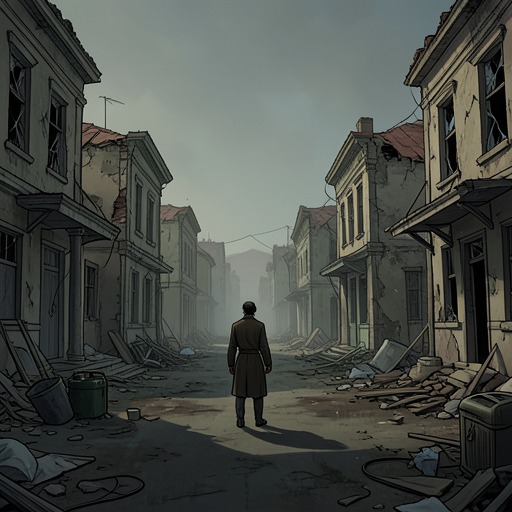
Jerusalem’s Lot is geographically legible but socially difficult to survey. Brock Street crosses Jointner Avenue at right angles through the nearly circular township, with the Royal River flattening the eastern boundary; on a map, the two principal roads resemble a telescopic sight. Yet the apparent clarity of the plan does not produce communal visibility. The southwest Bend is crowded with trailers, junked cars, children, recreational vehicles, makeshift washing lines, and hastily installed septic tanks. The area is physically connected to the town but economically and socially marginal, a place where households can remain obscure behind disorder, distance, and routine. The town’s relationship to the wider country is similarly insulated. National suffering reaches Jerusalem’s Lot only as something learned about at a distance, while local time seems to follow another schedule. The community’s confidence that nothing truly terrible can happen in such a pleasant little town becomes a form of protection for the outbreak. The town does not need to be sealed off for the infection to spread; its residents are already separated into private domestic worlds, and the absence of industry, dense neighborhood life, or sustained public scrutiny makes disappearance easy to overlook.
The Outbreak as a Hidden Social Process
The outbreak is first experienced through fragments that resist a common explanation. Susan Norton reports that a ten-month-old McDougall baby has died and that Mrs. McDougall has been taken away in restraints. Carl Foreman is missing, and so is the body of Mike Ryerson. Later, the bodies of Floyd Tibbits and the McDougall baby are also understood to have vanished from morgues, while Mike Ryerson remains unaccounted for. These incidents cross the boundaries between domestic tragedy, medical mystery, criminal violence, and corpse theft, but the authorities and survivors do not initially possess a language capable of joining them. The outbreak therefore advances through both blood and interpretation. A heart attack, a missing person, an unexplained death, a disturbed corpse, and a hospitalized family member can each be treated as an isolated occurrence. When Susan tries to test the vampire explanation against rational alternatives, she imagines that Matt Burke might have murdered Mike Ryerson, staged the room, planted Mike’s ring, performed a ventriloquistic deception, or used drugs to imitate illness. The point is not that these theories are plausible, but that ordinary causality remains easier to entertain than the supernatural. Even evidence that should clarify the case becomes part of the argument against belief: an autopsy, the absence of injection marks, and the question of motive all belong to a rational framework that cannot yet admit what is actually happening.
Medicine, Corpses, and the Failure of Recognition
Medical institutions become crucial sites of epistemic conflict. At the hospital, Jimmy Cody examines the evidence surrounding the deaths and missing bodies, but the formal language of diagnosis and autopsy cannot contain the pattern. He compares the corpse theft to a grotesque episode from horror cinema, while Ben Mears recognizes that the disappearance of Carl Foreman, Mike Ryerson, Floyd Tibbits, and the McDougall baby may indicate a much larger process. The morgue, which should stabilize the distinction between life and death, instead becomes porous: bodies disappear from under the observation of attendants, and the dead return as agents of the same violence. The outbreak also corrupts the ordinary meaning of bodily symptoms. Floyd Tibbits wanders through a day in a pallid, sickly daze, remembers only parts of his visit to Ann Norton, and experiences sunset not as the end of danger but as the anticipated beginning of something good. The change is simultaneously physiological, psychological, and predatory. A mother’s abuse has already bruised the McDougall baby’s neck before Danny Glick attacks it, making supernatural feeding indistinguishable from an existing record of human harm. The outbreak does not replace the town’s violence; it enters a community where private cruelty, secrecy, and neglect have already made vulnerable bodies difficult to read.
The Colony and Its Spatial Expansion
The vampire colony is frightening because it can be founded with extraordinary ease once the first vampire is accepted as real. Jimmy Cody observes that Jerusalem’s Lot is largely a bedroom community for Portland, Lewiston, and Gates Falls. There is no local industry whose absenteeism would immediately expose a crisis. The schools are consolidated across three towns, so a lengthening absence list may attract little notice. Many residents attend church elsewhere, many do not attend at all, and television has weakened the old neighborhood gatherings except for the older men who linger around Milt Crossen’s Agricultural Store. The social mechanisms that might once have detected a household in distress have therefore been eroded by commuting, institutional dispersion, religious disengagement, and private entertainment. This structure lets the colony occupy the town behind drawn shades. Ben Mears imagines people lying in beds, standing in closets, or waiting in cellars for sunset, with fewer residents appearing on the streets after each sunrise. The danger is not confined to one haunted building: it moves through homes and bedrooms, through cemeteries and morgues, and through the network of ordinary relations that allows one infected person to become another source of infection. The outbreak redraws Jerusalem’s Lot as a map of concealment. Places that had seemed peripheral or mundane become points in a nocturnal system whose true borders are invisible by day.
From Local Mystery to Total Darkness
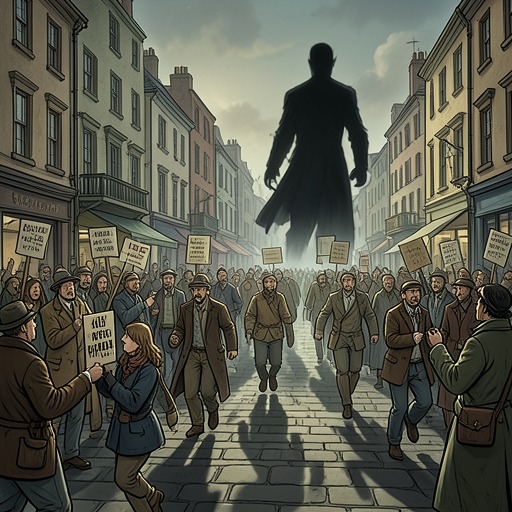
The outbreak’s emotional and metaphysical effect is expressed through the town’s altered atmosphere. Jerusalem’s Lot sleeps as it always has, but the sleep is no longer innocent; the Marsten House shines above it, its lights resembling the opened yellow pupil of darkness itself. The familiar town remains recognizable to passing drivers, who may see isolated houses fully lit in the morning and, finding no fire or accident, continue toward Portland. On Route 12, the streets are nearly deserted, outer houses have a shut-up appearance, and downtown shades are drawn. Nothing necessarily announces catastrophe to an outsider. The town can still be mistaken for an ordinary rainy small town. For those inside the crisis, however, the evidence accumulates beyond rational dismissal. Ben argues that if the events were an accepted public-health emergency such as typhoid or influenza, the town would already be under quarantine. The supernatural outbreak is thus made more dangerous by the absence of an authorized category for it. A recognized epidemic would trigger collective action; a vampire colony instead produces hesitation, private suspicion, and delayed response. The outbreak also embodies the novel’s larger conception of evil as mindless violence rather than a threat that can be negotiated with. Ben describes his subject as the town and the madness spreading through it, a form of violence that offers no escape through pleading, logic, or appeal. The outbreak gives that idea a social body: it is not merely one monster’s attack but a contagion that converts neighbors, relatives, patients, corpses, and whole households into extensions of an impersonal force.
Narrative Significance and Aftermath
The outbreak in Jerusalem’s Lot inverts the confidence associated with modern vampire fiction. In Dracula, modern technologies and methods help investigators identify and defeat ancient evil; here, electric lights, television, medical procedures, and bureaucratic routines help make the vampire unbelievable. The town’s modernity does not expose the incubus. It supplies explanations that delay recognition, fragments attention, and permits the colony to operate behind the surface of ordinary life. The result is a collapse of the boundary between a town and its darkness. The narrative repeatedly treats Jerusalem’s Lot as a collective organism whose residents belong to one another through gossip, habit, desire, fear, and shared sleep. Once the outbreak takes hold, that intimacy becomes predatory: the town is no longer merely a place where people know one another, but a system in which infection can travel through the very closeness that once sustained community. The Marsten House appears as the visible eye of the darkness, yet the darkness ultimately belongs to the whole town. Its final significance is therefore both supernatural and civic: evil wins ground not only by attacking individuals, but by exploiting the ordinary structures through which a small community fails to see itself.